

- Green transition community must find more effective ways to engage in dialogue with corporations that can easily issue bonds or hold massive cash positions
- Tools like universal proxies or Schedule 13D filings are key, but success requires precise number crunching research
- Aligning a carbon asset, such as PolyJoule, to offset entities like IPEX or Aliaxis carbon liabilities
Here’s a notable data for you. They’re seven companies in the Construction & Engineering (C&E) and Power Sector listed on the Science Based Targets initiative (SBTi) database with direct or indirect use of Polyvinyl Chloride (PVC), who aim to be Paris-aligned in the near-term by 2030-2035.

Another data point to consider: Sixteen sectors from the Science Based Targets initiative (SBTi) utilize PVCs in various forms, spanning industries such as Air Freight Transportation, Electric Utilities, Automobiles, Construction, Healthcare, and more. PVC is found almost everywhere and its one of the top three most overly used plastic globally from pipes & fittings, films & sheets, profiles & tubes, bottles, and cables, with the profiles & tubes taking the largest market share under the segment.

Here’s the thing. Looking solely at the Polyvinyl Chloride (PVC) market, particularly in the context of traditional debit and credit cards. Conventional PVC is commonly used in the production of these cards. In the United States, the aggregate number of Visa and Mastercard cards in circulation witnessed an increase from 1,920 billion to 1,945 billion in Q2:2023. Notably, CPI Card Group Inc. (Nasdaq: PMTS) is a key provider of traditional PVC cards to both Visa and Mastercard.
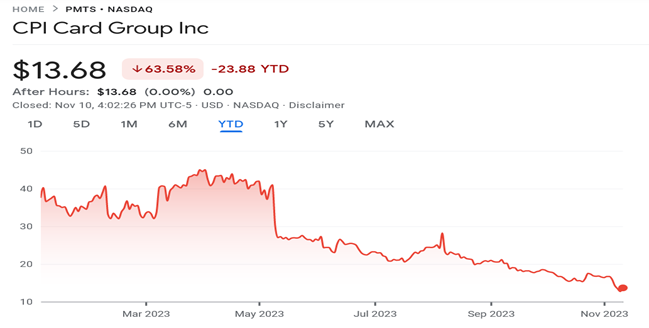
With all the aforementioned data in mind, you may be wondering: How does one go about decarbonizing the PVC market? Why would a company with a stock that has collapsed by 63.58% be interested in decarbonizing? Panic calls for solutions, and solutions that can generate revenue find receptive ears during moments of panic.
The well-known Jim Rogers once said, “The last leg of a bull market always ends in hysteria; the last leg of a bear market always ends in panic.” Applying the same framework to decarbonizing the PVC market, an “Activist Investment Consultant” or an action-oriented “Climate or Environmental” activist can utilize this opportunity to enter the relatively quiet and less-explored PVC market.
Gone are the days of influencing corporate decarbonization from the global stage (i.e. COP28 or protests). Tools like universal proxies or Schedule 13D filings are key, but success requires precise number crunching research to influence capital allocation into sustainable investments (i.e. renewables, emission offsets or technology-neutral tools).
Entities desire to make shareholders profits, and when solutions can aid in times of panic to shore up top and bottom lines, entities listen. For effective activism, climate advocates must pinpoint how public companies can profit from sustainable investments or selling carbon offsets. Understanding these financial dynamics is crucial for impactful and successful initiatives, and catching it too late can hinder shareholders or board members in allocating capital to any sustainable investments that can propel them up the ladder to decarbonize. Hence, we need to fine-tune our rhetoric away from name shaming to metric-based improvements.
Consider the following strategic approach:
1. Acknowledgement
2. Number Crunching
3. Technology Neutral projects needing Investments or Partnership
Acknowledgement
In exploring the efficacy of metric-based improvements within the PVC industry, recent developments underscore the industry’s responsiveness to the expanding green transition. Notably, companies are increasingly incorporating bio-based PVC materials.
In North America, for instance, a prominent PVC entity, IPEX, is utilizing Hydro-Québec’s pilot project to power its Quebec production plants entirely through renewable energy. This presents an opportunity for stakeholders in the carbon offset and ethylene emissions offsets sectors, or for activist investors.
Perfect. You’ve identified a player with prior or current interest in decarbonizing. Next step!
Number crunching
Now, table out a robust market research, number crunch where a percentage of capital can be allocated to decarbonize while presenting profit returns to shareholders.
Rather than engaging in a broader discourse on how advancements are either not being made or are being overlooked, it is crucial to scrutinize annual reports. Identify potential avenues to enhance Environmental, Social, and Governance (ESG) practices and engage in dialogues with industry suppliers and stakeholders to contribute to the industry’s long-term sustainability. This should be done without resorting to exhaustive ESG materiality checklists that may not resonate with shareholders or stakeholders, especially in times of panic.
A departure from mere finger-pointing is imperative as COP28 approaches. The green transition community must find more effective ways to engage in dialogue with corporations that can easily issue bonds or hold massive cash positions. The PVC industry, like many others, is actively seeking sustainable strategies that not only align with shareholder interests but also yield profits.
Technology Neutral projects needing Investments or Partnership
In a recent development on June 14, 2023, PolyJoule, a pioneering manufacturer of conductive polymer energy storage, took strides within the PVC industry and unveiled a groundbreaking process. This innovation transforms PVC (polyvinyl chloride) into PolyJoule’s patented conductive polymers for use in batteries. Dr. Eli Paster, CEO and Co-Founder of PolyJoule, emphasizes this development as a crucial move in advancing sustainable initiatives across the chemical and energy sectors. By leveraging a small percentage of global PVC production capacity, PolyJoule aims to meet half of the projected 2027 annual stationary storage demand, marking a substantial contribution to sustainable energy solutions.
Rather than engaging in a broader discourse on how advancements are either not being made or are being overlooked, it is crucial to scrutinize annual reports. Identify potential avenues to enhance Environmental, Social, and Governance (ESG) practices and engage in dialogues with industry suppliers and stakeholders to contribute to the industry’s long-term sustainability. This should be done without resorting to exhaustive ESG materiality checklists that may not resonate with shareholders or stakeholders, especially in times of panic.
A departure from mere finger-pointing is imperative as COP28 approaches. The green transition community must find more effective ways to engage in dialogue with corporations that can easily issue bonds or hold massive cash positions. The PVC industry, like many other industries, is actively seeking sustainable strategies that not only align with shareholder interests but also yield profits. Aligning a carbon asset, such as PolyJoule, to offset entities like IPEX or Aliaxis carbon liabilities is a singular solution that contributes to the effort to decarbonize the PVC market, as long as top and bottom lines are shored up.